
Tooling
Technical Content Delivery Portal
Products that ship content.
Discover technical publications software designed to streamline your standards and content workflows. From drafting and collaboration to publishing and delivery, our content services and technology simplify complex processes and bring everything into one intuitive platform.
Eliminate Document Chaos. Delight Your Users.
Shakewell Content Portal
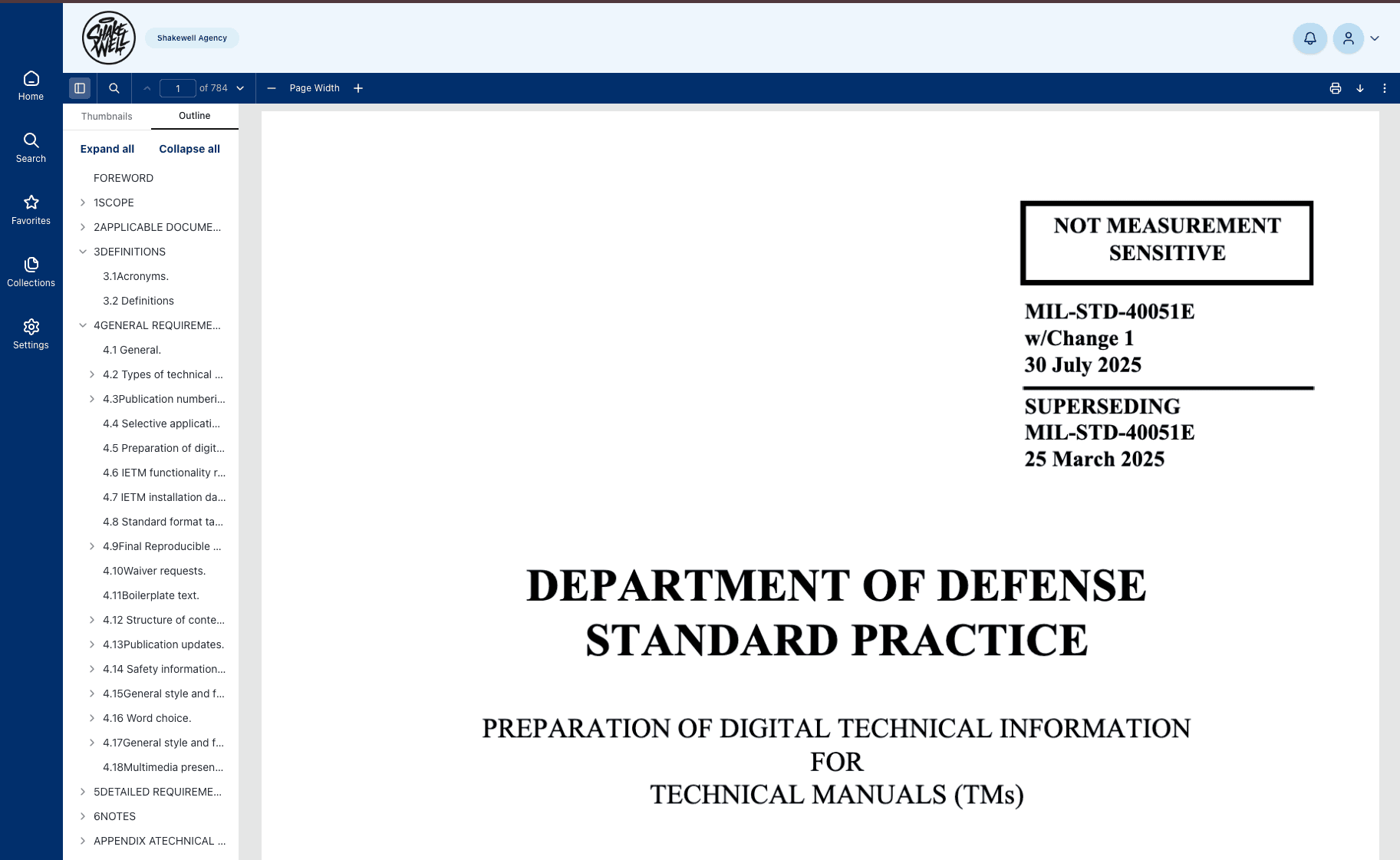
Deliver your technical publications through a sleek, intelligent portal that empowers your customers and streamlines your internal workflows.
Do customers complain that your technical documentation is hard to find and difficult to search? Do your technical writers find it a headache to maintain?
Our content delivery portal transforms your static documents into a dynamic knowledge hub with powerful search, granular access control, and insightful analytics. Reduce support tickets and empower customers to succeed.
Built on
Powerful search
Turn static documents into a dynamic knowledge hub where customers find the right content fast.
Granular access control
Decide exactly who sees what, with permissions scoped to customers, teams, and documents.
Insightful analytics
See how your documentation is used, reduce support tickets, and empower customers to succeed.
Choosing a System
How to Evaluate a Technical Publications System
We are asked to compare authoring platforms, content management systems, and delivery portals more often than we are asked to sell one. These are the questions that separate the systems that survive contact with a real program from the ones that demo well — whichever vendor you end up with.
Native standard support
Is the standard native, or bolted on?
A system that stores your content as the standard's own data model behaves very differently from one that stores something else and exports to it. Ask which issues and revisions are supported natively — S1000D 4.x versus 5.x versus 6, MIL-STD-40051, iSpec 2200 — and what happens on the day the specification revises.
Source management
Where does the source actually live?
S1000D expects a Common Source Database; DITA expects a component content management system. Either way you need check-in and check-out, versioning, branching for concurrent revisions, and a single authoritative copy of every module. A folder of XML files on a share drive is not a CSDB, however well organized.
Applicability and effectivity
How does it handle multiple aircraft from one source?
This is where small teams running mixed fleets get hurt. One procedure that differs across three tail numbers should be one module with applicability expressions, not three near-identical copies that drift apart. Ask to see applicability resolved at publish time against a real configuration, not described on a slide.
Business rules enforcement
When does non-compliant content get caught?
Validation against the governing DTDs, schemas, and business rules should happen while the author is writing, not in a delivery review three weeks before the drop. Ask whether BREX and equivalent rule sets are enforced at authoring time and what the author sees when a rule fails.
OEM and supplier data ingestion
What happens to data you did not author?
Operators rarely control the format their OEMs deliver in. A centralised documentation operation lives or dies on how well it absorbs mixed supplier data — different standards, different issues, different levels of compliance — without hand-rebuilding each drop. Ask what the ingestion path looks like for a supplier who sends you legacy PDF.
Illustration pipeline
How are graphics managed and reused?
Technical illustrations carry their own control numbers, revisions, and hotspot data linked to parts. Ask how illustrations are stored, how ICNs are allocated, whether hotspots survive a revision, and what happens when one graphic is reused across many modules.
Output channels
Can one source produce every deliverable you owe?
Most programs owe more than one format: page-based PDF for the contract deliverable, an IETM for the maintainer, a portal or EFB view for daily use, and something that works with no connectivity in a hangar. All of it should come from the same source without a parallel production process per channel.
Security and export control
Does the deployment model match your obligations?
Distribution statements, export-controlled content, and customer security requirements constrain where content can be hosted and who can see it. Ask about deployment options — cloud, on-premise, air-gapped — and whether access control is granular enough to scope permissions by customer, team, and individual document.
Migration in, and migration out
How do you get your content back?
The migration into a platform is quoted and planned. The migration out usually is not, and it is the question that tells you how much leverage you are giving up. Ask what a full export looks like, in what format, and whether it round-trips into another compliant system.
Working through this list is exactly what our analysis and strategy engagements do — platform selection and build-versus-buy evaluation against the standards your program actually owes. Most of them end with a recommendation for a platform we do not sell.
FAQ
Choosing a Platform
What should a small maintenance team look for in a technical publications system?
Applicability handling first. A small team running several aircraft types gets hurt most by duplicated content that drifts, so the ability to hold one procedure with applicability expressions across tail numbers matters more than feature breadth. After that: native support for the standard you actually owe, validation at authoring time rather than at delivery, and an honest migration path out.
How do authoring platforms differ from content delivery portals?
An authoring platform is where technical content is written, validated, and managed against a standard. A delivery portal is how that content reaches the people who use it — maintainers, customers, dealers — with search, access control, and usage analytics. They solve different problems and many operations need both. The Shakewell Content Portal is a delivery portal; we work with whichever authoring platform a program already runs.
Can one system manage documentation from several different OEMs?
Yes, but the ingestion path is the thing to examine rather than the claim. Suppliers deliver in different standards, different issues, and different levels of compliance. A centralised operation works when there is a repeatable pipeline that normalizes incoming data — including legacy PDF and unstructured content — into your own source of truth, rather than a manual rebuild on every drop.
Does Shakewell only recommend its own products?
No. Platform selection and build-versus-buy evaluation are part of our Analysis & Strategy practice, and most engagements conclude with a recommendation for a platform we do not sell. We build the Content Portal for delivery, and we author natively in S1000D, MIL-STD-40051, MIL-STD-3001, iSpec 2200, and DITA across whatever toolchain a program already owns.

See It in Action
Let's Talk
Walkthroughs and demonstrations of the Content Portal are available on request. Tell us about your content and we will show you what it looks like inside the platform.
or email hello@shakewell.agency